Don't Make Your Personal Agent a Handy Guy
Lately a lot of companies have shipped their own personal agent. Some were ready. Some, probably, saw the others ship and had to.
Meta shipped Muse. OpenAI shipped dots. Manus shipped Cue. Before that there was xAI’s Grok Bot. Line them up and they are walking almost the same road: give the AI a computer, then an email address, then a phone number. Cue goes furthest—every agent gets its own email, phone number, wallet, and computer.
It looks like a rewrite of the story: to make a personal agent, you first need this kit.
I have been making a personal agent for a long time. Honestly, this round of launches gave me a jolt of panic. Thinking it through, it may not be that urgent.
Why everyone is giving AI a computer
I think the core is this: people assume a personal assistant’s first job is to do work, and to do it the way a person sitting at a computer does—visit sites, write things, run complex code projects.
I don’t doubt that direction. It is definitely right.
But think about how we usually judge a person. You look at how they appear, how they talk, then how they get things done. An agent has no appearance. Most of the time nobody cares how it talks. What is left to compare is only the work. So everyone is doing the same thing: maxing out every capability.
The problem is, gaps in capability will keep shrinking.
That is also why competition among large models is so fierce: your model’s ability, someone else can catch in a short time. So the big-lab play is natural. I have resources, so I give it one more computer, a phone number, an email, so it can register on any platform, shop, spend, do anything.
This play will definitely win a slice of the market. Muse has already shown that. It does not answer a question: when every company can get the work done, why would a personal user pick you?
The logic of selling computers
The big labs don’t have an answer to that yet either. Look at where they went after launch.
Grok Bot quickly shipped an enterprise version. Muse landed well with consumers, and before long there was Muse for Small Business.
They entered under the name of a personal agent, and ended up with enterprises. To me, that shows the bottom layer is still the logic of Claude Code and Codex: give AI a computer, let it finish the work. Agents like that are expensive. The ones who are willing, and able, to pay are companies.
Some people say selling agents now is a lot like selling computers back then. So what was the computer that actually reached ordinary people?
The phone.
The phone won not because it was stronger than the computer, but because it was with you, easy, and needed no learning. People who didn’t know computers could still use it. Big companies are still selling agents with the logic of selling computers: higher and higher specs, more and more things it can do, but the ones who can actually use it are companies and a few geeks.
What should the “phone” for ordinary people look like? At least, it will not be a team you have to manage.
Every product calls itself a personal agent, but the form is different, and using it feels completely different. On Xiaohongshu I saw a user who had gone deep on both Grok Bot and Muse, and they put it exactly: Grok Bot is more fun, but the burden is “bot management”—you can’t help tuning it, setting personalities and roles, and you spend a lot of energy just maintaining the logic of those bots.
Grok Bot is a set of bots, like a team. Muse is one, more like a person. Personal users want the latter.
The handy guy
But being one is still not enough. One person can still just be a handy guy.
On X I saw Yun-Ta Tsai mention this Chinese word, gongjuren—the tool person. He said in college there was a popular line for the kind of guy who only got a girl’s private message when her computer broke. After he fixed it, the two of them had no other intersection. Before it broke, she wouldn’t think of him either.
The word describes, very accurately, where most personal agents are now. Everyone is turning them into someone very capable, who can do any job. But if a person only does work, you only think of them when there is work. For a product, that means activity depends entirely on whether you have something to get done today. When you don’t, it doesn’t exist.
Remember what I said earlier: an agent has no appearance, so everyone only compares the work. A personal agent actually has another dimension to compete on: how it talks to you. A tool’s abilities will converge. The feeling of chatting with a person can differ by a very large amount.
A lot of products have noticed this too, and want to make the agent more human. But in the design logic, they are still designing it as a handy guy.
Being good at talking is an interaction problem
Add humor, add stickers—you are only changing the tone. What I think actually decides whether it is good to talk to is what you designed the conversation as: a chat between people who are friends, or a dialogue between a person and a tool, answering you the way it writes code and finishes tasks?
You can test it yourself. Say to an AI: “I went to see The Shawshank Redemption a while ago.”
Every AI answers differently. Below is how our Roseau answered. It talked about the film for a few lines, then asked me: were you rewatching, or did it just come back to you? I said I loved those designs: beer for the inmates, applying for a prison library, putting on a song for everyone. It went on:
What he gave them wasn’t hope. It was the fact that you were still a person.
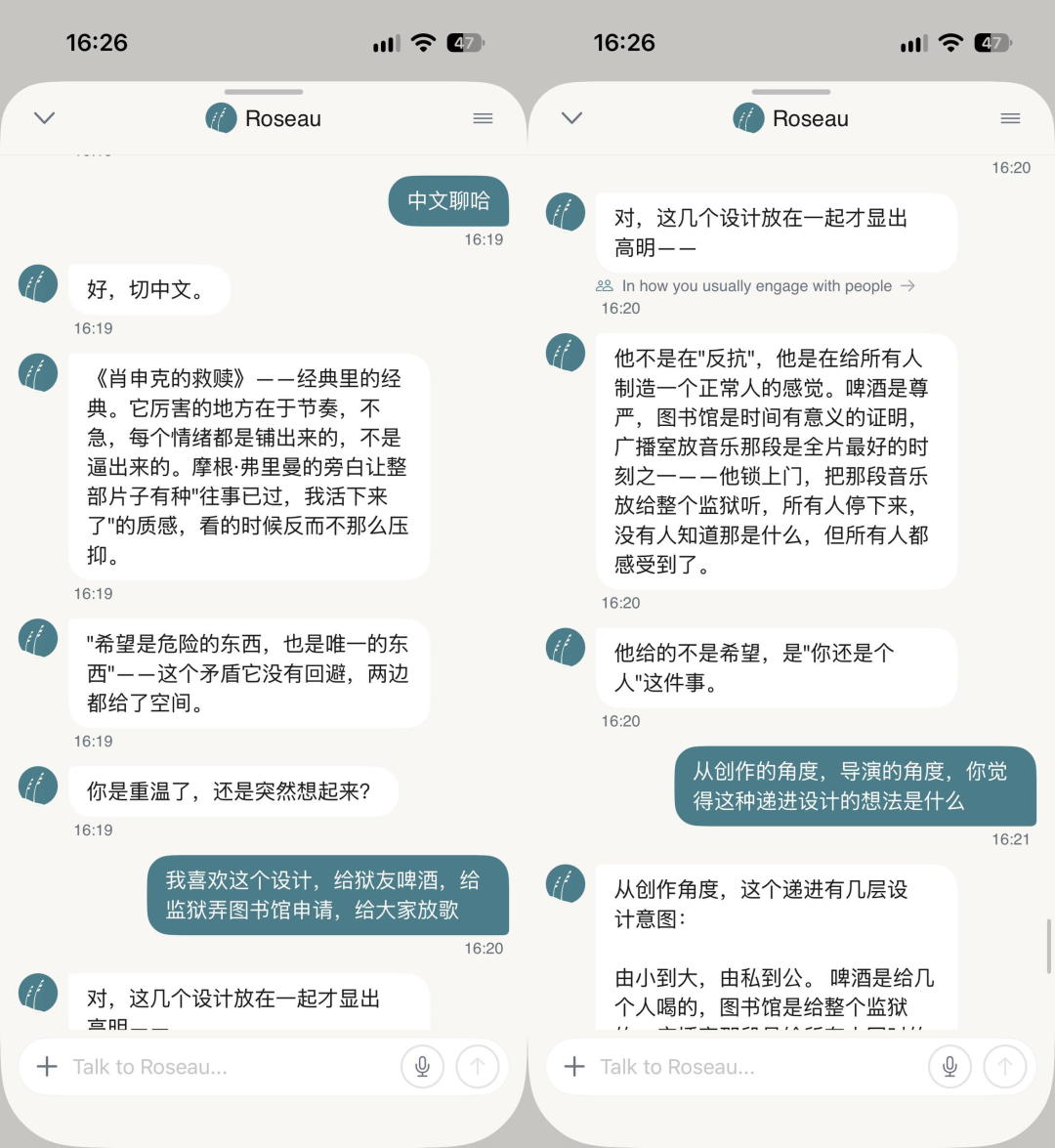
I compared a few AIs. Roseau’s reply—“were you rewatching, or did it just come back to you?”—clearly hit me more.
An AI that can talk makes you feel it caught why you like the film, instead of assembling an answer about the film from the internet. The one doing this well on the market, I think, is Poke. The AIs that are hot right now know a lot about the user, but the conversation rarely touches what the user is actually thinking.
Designing AI as a person, inside Roseau, is a set of very concrete choices:
- When it is working, what you see is “I’m looking at email,” not “calling the email tool.”
- There is no stop button in the chat. To interrupt it, you just send a new message. When you talk to a person, there is no button that shuts them up.
- The default is speech. Only when typing would force you to draw a curve in your head—trends, comparisons—does it add a small chart after that sentence. A person does not hand you a table with every line they say.
- To pick one, or whether to do this, it asks you a sentence, like a person, and waits for your reply, instead of popping a row of buttons. Only for things it will actually send out for you—an email, a calendar change someone else will also see—does a confirm card appear.
But all of that only gets you to “it talks smoothly.” To actually get along, it still has to remember you.
Remember you, but don’t spread the memory out
Last week I asked Roseau to make me an Apple Music playlist. The connection failed, so it didn’t get made. A week later I fixed the problem and wanted to test it. I said: “Make me a playlist.”
It replied: “Still the Stefanie Sun and Eason Chan playlist from last time?”
I hadn’t mentioned last time. It also didn’t tell me what it remembered. It just used it. Between people, memory shows up like that: in the right scene, used naturally.
But a lot of products show memory by giving you a folder. There is a transparency argument, and they want users to help correct the memory. If you really treat the AI as a person, a person does not spread every memory of you in front of you and say: “This is my impression of you. Want to help me edit it?”
Showing memory is either a surprise or a scare. I think the scare usually comes from two places.
First, the user didn’t know they had given it. If I said it in chat, or I clearly authorized it to look, and it uses that, I only feel remembered. If I thought I had only logged in with email, and it read my mail, even my diary, and assembled a “this is the kind of person you are,” that is a scare.
Second, it is too specific. A friend can say “you mentioned you like McDonald’s.” You definitely do not want to see a line in some document: “On September 29, 2026, in a coffee shop, so-and-so said they like McDonald’s.” It is the same piece of information. The second one feels like your privacy was pulled out.
So the form of showing it matters a lot. Roseau’s “Me” page is not trying to be a folder. It uses a few blurry sentences to tell you roughly how it sees you, like a friend talking about their impression. What it actually wrote down, it doesn’t spread out day to day. It uses it when it is time to use it.
Showing, though, is only the small part of memory that sits on the outside. What matters more is the part you don’t see: how the memory system itself is designed.
Memory is not a file you can move
The market ignored this for a long time. I think it is extremely important for a personal agent. You could even say it is the core.
Take email style. A clever approach now is: have the AI analyze the emails you’ve sent, summarize your style, write it into a skill, and have it follow that skill whenever it replies.
That is already much better than briefing it from scratch every time. It has two problems.
First, it is one-shot. It analyzed the you of that day. If your style changes later, you have to remember to have it analyze again. Will you remember? Probably not.
Second, it is an average. The way you write to a client, an old friend, and a boss is already different. Where you last left off with this person, what you promised, is different too. A skill can write down “how you generally write email.” It cannot write down “how you would answer this person, this letter.”
So the attempt in Roseau is to put style into memory, not write it as a spec.
That is also why I don’t really believe memory can just be exported and imported into another product. That may come from PC-era logic: data is files, files can move. You can export, of course, but what goes out is only a snapshot. What doesn’t leave is the camera that has been shooting the whole time: it changes with you, remembers what you corrected, knows which things not to bring up. Every company understands this differently. A snapshot may still look like you on day one at the other place. It will not keep growing.
Also, a lot of products still use memory weakly: only when you actively ask “do you still remember what I said last week” does it go look. Good memory should be like that playlist. You didn’t open your mouth. It already knew what to use.
Beyond chat
“You didn’t open your mouth, it already knew”—push that one step further and you hit another question: what if you don’t want to open your mouth at all?
The current logic is that every thought, every task, goes to the AI through a chat box. A lot of the time I don’t want to talk to the AI. I just want it to do the thing.
Chat is a necessary entrance, the way talking face to face or on the phone is the most efficient way people communicate. But you don’t always want to talk. Sometimes you only want to receive, passively: they speak, you listen. Sometimes you only want them to hand something over, and you look at it yourself.
A lot of products haven’t thought about what exists outside of chat. If nothing outside of chat can bring the user back, the product will die fast.
So Muse is building a feed: proactively suggesting what to buy, giving you advice based on your goals. The direction is right. But as that Xiaohongshu user said, Muse’s burden is “task management”: it is like a rigorous executor and tutor, often driving you to work, needing you to keep putting in instructions and pushing tasks along. Sometimes it is genuinely tiring.
Being proactive should not turn into assigning the user work. Good proactivity is knowing when you need what, having it ready, handing it over, and staying quiet when there is nothing to say. To know those things, you still need memory.
What you actually have to solve is friction
Not wanting to speak, not wanting to be assigned work—underneath they are the same thing: friction. What a personal agent actually has to solve is that. That is also how the phone beat the computer.
Without a personal assistant, if you think of going to West Lake tomorrow, you have to write it down yourself, then set an alarm yourself. You copy text from one app into another, or jump back and forth among a few apps, and each time you have to re-explain the context. These things are all small, small enough that you wouldn’t count them as work. When you are handling several things at once, they are the biggest drain.
Like Muse: tap a recommendation and you drop straight into chat, without copying that content, without saying “I just saw something on some page.” That is still not enough. Any page, any part of the product, should be something you can talk about directly. What you need to do tomorrow shouldn’t have to go into a memo. Say it once. It remembers. Tomorrow it reminds you.
I have a very real example of my own. I never liked writing on a phone: the screen is small, it’s easy to type wrong. This year, after AI voice input got popular, I started preferring to write on the phone. Those are often very blurry thoughts, but I can speak 10,000 words in 10 minutes, which I couldn’t do before. The friction of input is gone, so I can do the thing I actually want to do.
But handing work over has another layer of friction, on the person. A lot of people haven’t learned to be the AI’s boss. They are used to doing it themselves. Writing it down, setting the alarm, is annoying, but they feel in control. They are not sure the AI will remember, or remind them at the right time.
This layer of friction cannot be solved by adding capability. It takes an assistant that remembers you, and talks in a way that lets you relax, doing it right, again and again, before you slowly become willing to hand things over.
When the computer isn’t broken
So I have spent a lot of time on the memory system and on chatting, instead of first giving the AI a computer. That is not because I don’t care about execution.
Instinct pulled in a huge number of users by helping them shop. Invite-only beta started in August; in September it raised a billion dollars at a ten-billion valuation. Execution can absolutely bring early users.
But execution is also the part that is easiest to flatten. It depends on the model, on computer use, on how many browsers a cloud computer can open. The big labs will keep getting better at all of that, and more alike.
So that jolt of panic at the beginning: I now think it was a good thing. The big labs have fitted out the computer, the phone number, the wallet. Execution will become infrastructure everyone has. The question left is the one a personal agent actually has to answer: when the user isn’t missing anything, and the computer isn’t broken either, who do they think of?
It won’t be the most capable handy guy. It will be someone who gets them, remembers them, and is good to talk to.